Sep 21, 2010

When All Else Fails . . .

. . . Follow Directions!


Lace shawls are all the rage now, with both knitters and crocheters.  I think their ethereal beauty is what has been drawing fiber artists to them in droves in recent years.  I've started making lace shawls, largely because of a real need to bust my stash, particularly of the lovely fingering and sock-weight yarns I have been lucky to receive in my various Ravelry swaps.

My current project is the Ostrich Feather Fandango Shawl, created by Tracey McCorkle.  It is a very different shawl; its feathered shells add a three-dimensional quality to what traditionally are flat, two-dimensional pieces of fabric.  See what I mean? It looks like it is ready to take flight.  
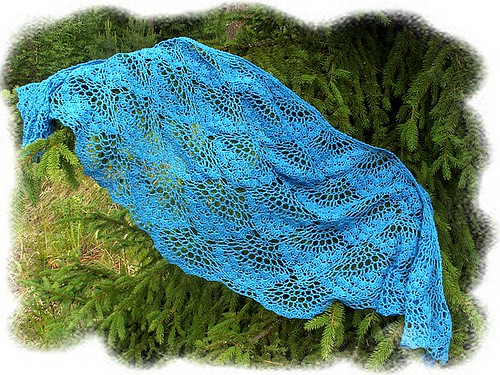


This beautiful Ostrich Feather Fandango Shawl was crafted by 

Siljuska 

from Finland.  I only hope mine turns out as well. 

Linda, my friend and crochet mentor, often jokes that I am an "uptight crocheter" because I tend to crochet on the tight side.  One would think I would have a strong preference for following written crochet instructions.  Hah!  I embarked on this project much in the same way I approach most of my crochet jobs crafted from someone else's pattern.  First, I glance at the pattern, then memorize any repeat, and wing it from there.  Unfortunately, my modus operandi didn't work here.  Unlike all other shawls I have made, this pattern is not symmetrical, although the result is supposed to be.  Clear as mud?


Rows 1 through 14.  All was well -- symmetry reigned.  
Row 15.  A shell seemed to be missing.  Okay.  Easy fix.  I added one.
Row 16.  Don't know why but it started with a sc but ended with three dc. Again, the shells were off.  Thank goodness shawls are symmetrical and it is easy to match up the right and left sides.  Fixed this one.
Row 17.  Ughh!  My wide shells and open shells and closed shells seemed to fall in all the wrong spots.  And that nonsense about starting the row with a sc and ending with a dc just didn't seem right, right?
Row 18.  Damn!  Nothing is right.  In fact, it's looking more than a bit lopsided.


Made the decision to frog, to rip back to the last symmetrical row. Printed out an updated version of the pattern, studied the offending rows, and marked up the margins like I used to do when cramming for college finals.   


Row 15, again.  Ignored the obviously missing shell.
Row 16, again.  Worked it as written.  Still not comfortable starting with a sc and ending with a dc.
Row 17, again.  Made sure to count every stitch.
Row 18, again.  Things are looking up. I'm beginning to see the symmetry. In fact, it's no longer lopsided.
Rows 19-21. Making progress.  Finished the first repeat, although row 21 was a bit convoluted!  
Rows 22-26. Finished the second repeat.  Only another four or five repeats to go.


I guess I should have taken Tracey's cautionary notes to heart:

"PLEASE READ ALL INSTRUCTIONS, INCLUDING THE NOTES AT THE END OF THE PATTERN, BEFORE ENDEAVORING TO BEGIN YOUR SHAWL. THE NOTES FOLLOWING THE PATTERN WILL BE TO YOUR BENEFIT, AS THE SHAWL IS NOT SYMMETRICAL WHEN THE PATTERN IS BEING WORKED."

Tracey notes that several people have complained about the pattern because it is not truly symmetrical, although the finished product looks symmetrical!  Last week, i would have been among that crowd.  Now, after frogging, I see the error was with with me rather than with Tracey's pattern.  Admittedly, I would only recommend this pattern for advance crocheters who feel they can grasp the pattern and then recreate it themselves through the repeats.


Now that I am following directions, this shawl is going to be beautiful when completed.  I already have a recipient in mind.

Sep 11, 2010

Playing Hooky

"My name is Victoria and I am a truant blogger."  Lowers head in shame.  "It has been more than six months since my last post (not counting last week)."


You are now supposed to say, in unison, "Hi, Victoria."


With blog truancy comes guilt.  True, I have not blogged much this year (as my sister Constance is wont to remind me of on a rather regular basis), but I have not strayed far afield the world of crochet.  Although I have had a lot of work and family demands during that time, I did manage to play a little "hooky."
  
In February, I felted my first Fedora hat -- four skeins down but first, I had to add them to my stash.  In May, I made a pair of mittens -- two skeins used but purchased four more to finish the mittens as well as another pair.  In July, I attended the Knit and Crochet Show in Manchester, New Hampshire, where I picked up nine skeins of yarn.  Later that month, I made a silk purse, using up one skein purchased in NH and another purchased to finish the project. I also added a double sized skein to justify the cost of shipping.  In August, I made Vicki Mikulak's Flying Diamonds Shawl; although beautiful and fun to make, it was not quite a stashbuster at less than 2 skeins.  In the early days of September, I finished a cover for a hot water bottle, using yarn gifted from one Raverly swap partner.
My yarn adventures introduced me to several new yarns, including a couple that already were in my stash:


Frog Tree's Picoboo -- a pima cotton/bamboo blend in a sport-weight yarn that is actually closer to a light DK.  Wonderfully soft, it drapes well and shows stitch definition without being stiff.  Here it is worked up into a hot water bottle cover.


Habu Textiles' A-111 1/2.5 Tsumugi Silk Combination -- an unusual 100% silk yarn that has several colors within each strand.  This is not a yarn to highlight highly textured crocheted stitches, although it does an admirable job of subtle stitch definition, such as Dee Stanziano's Pushmi-Pullyu stitch technique.  Why this yarn is called a fingering weight yarn, I don't know.  rather, it works up like a DK and most folks are using a 6 mm needle or 4 mm hook.  Here it is as a silk purse.


StyleCraft's Signature Chunky -- this "Plain Jane"-named yarn is far from nondescript.  A 50/50 wool/acrylic blend from Britain, it is luscious and very soft, and, dare I say, inexpensive.  I started off with two skeins but had to order more to finish these mittens in the Peacock colorway.  I even ordered extra skeins so I can make a set for myself. This picture does not do them justice.


Looking back, several projects were completed, but overall, not much stashbusting done.  Counting yarn gifted from swaps, yarn purchased by me for me, yarn gifted to others during swaps, yarn used to make various projects, and yarn purchased to complete projects, I would say that my stash remains about the same.  Playing hooky has been productive.

Sep 6, 2010

Angling this Fishing Yarn

          Labor Day typically signals the unofficial end of summer.  But out here in the Washington D.C. metropolitan area, Labor Day weekend typically is hot and humid, steamy at best. But thanks to Hurricane Earl (who knew one could ever be grateful for a hurricane), the weather here this past weekend has been nothing short of beautiful.  So I fought the urge to spend the holiday weekend as I typically have done in the past -- at home, sometimes with a grill, sometimes with a crochet hook, but always getting the kids into a back-to-school frame of mind. This year, we made the two- hour drive to Maryland's Eastern Shore to visit old friends.
          N and S live on the Choptank River, where I thought it would be fun to fish off their brand new pier, which had not been inaugurated, not counting their curious orange tabby or their always curious Kerry Blue Terrier.  I also thought fishing might keep the girls from getting bored.  So as we headed east, I picked up a couple of simple (read cheap) rod and reels and a couple of hooks and lures.  We were all set.  I also brought my current crochet project with me, just in case.
          First, I taught the girls how to cast off (no, not knitting, this is a crochet blog).  For you non-anglers, casting simply is the act of throwing the fishing line out over the water using a flexible fishing rod and reel.  Vashti soon became quite adept at casting with her closed spin cast reel.  It took Lariat a bit longer because I had saddled her with an open-face spinning reel, but she also was casting with confidence.  Before you ask, no, no fish were harmed during this escapade.  In fact, no fish were even caught, although Lariat got two nibbles that ripped the hook off the line, and I got a heck of a pull that ripped the hook and bobber clean off the line.
          This is where this fish tale connects to crochet.  It soon became evident that I had made the mistake of buying reels with 8 pound test line - so thin you can bite it clean through with your teeth.  To add insult to injury, the reels were cheap.  I moved from Lariat then to Vashti to untangle their lines.  And just as with a tangled ball of yarn, my first urge was to tug and  attempt to unweave the knots.  But, thankfully, I remembered my previous forays into detangling yarn and stopped trying to outhink the tangles and twists.  
          That afternoon, as summer was singing her swan song, I sat patiently on the dock untangling fishing line. As the sun began to set, turning the water from a cold dirty blue to a shimmering orange, I donned my sweater and sat patiently on the dock untangling fishing line.  Eventually, it was to time to "cut bait."  The tangles won out. Weak filament plus cheap reel equals tangled line. You could say I got what I paid for.
          Although the fish proved as elusive as an untangled line, we did enjoy good weather, good food, and good friends.  I even came prepared for a bit of crochet and came away with this fishing yarn. 
          Wishing you all a wonderful Labor Day weekend.  

Feb 22, 2010

Commuting with Fiber

Source unknown.  Received this photo via e-mail several years ago.  The man knows how to make a statement! 

I'm a commuter.  I take the bus and then the Metrorail (i.e., a subway that runs a significant portion above ground).  My door-to-door commute runs about 45 minutes on average but somedays, due to weather or a sick passenger, it can drag on another 15 minutes.  I used to think I was one of the lucky ones until I read that local commuters in the metropolitan D.C. area spend an average of 33 minutes getting to work, nearly 8 minutes a day more than the national average, according to data released last September by the U.S. Census Bureau's American Community Survey.  But, despite a commute that is 12 minutes longer than the regional average, I am still better off than the more than 100,000 local workers who spend 90 minutes or more commuting to work.  Most of them do it behind the wheel of a car.  I do mine behind the head of a bus driver or train operator.

Despite the seemingly cranky mantle I wear when I finally arrive at the office, I secretly like my commute.  Commuting via public transit provides the most wonderful opportunities to read a book in peace (no constant interruptions for "Can we go . . . " or "What's for dinner?").  Commuting via public transit also allows long stretches of down (as in sitting) time during which I can take out my project bag and start hooking away.  Despite the relatively short commute time, I can rock out a hat in two days of commuting, a small neck scarf in a day.  Although I miss listening to the radio (Amy Goodman of Democracy Now! rocks) during my daily commute, I no longer enter the building already the stereotype of the harried government worker.  What shape I am when I leave the building is another story altogether.

Unfortunaltely, the needle arts are not as popular among the commuting set as reading the Washington Post (or its unfortunate little offspring, the Express that often is left on seats for others to enjoy), listening to the latest tunes with expensive I-Pods with cheap earphones that allow folks two rows away to "enjoy" the music as well, or simply staring off into space.  But every now and then, I run across a kindred soul who industriously spends this precious time indulging in these ancient arts, unknowingly keeping them alive for future generations.  Sometimes our eyes will meet and we smile a knowing smile, sort of like an invisible nod of acknowledgement.  If we are within talking distance, we politely, so as not to bore the other passengers, inquire about the project but it's a bit like talking in a secret code:
  • "That's a lovely blanket you are crocheting/knitting" translates to "You go, Girl! I love public displays of fiber."
  • "What yarn/pattern are you using" translates to "You are not alone.  There are a lot of us hiding in plain site."
  • "Have you been to XXX local yarn store" translates to "There's a place where folks like us meet up. Perhaps you would like to join our secret society."
Then the train or bus stops and one of us departs for work or home.  Thus endeth the secret dialogue and we sadly pack up our yarn and hooks and prepare for what lies ahead on our desk or in our kitchen.

Perhaps my crankiness upon arriving at work is not a facade.

Feb 10, 2010

Size Matters ! ? ! ?


Source:  Flying Finger operates its YarnBus, a free shuttle from Manhattan to its store in Westchester, NY.  

Yarn, like so many other things (balls, underwear, people, crochet hooks, etc.) comes in a variety of sizes.  And with different proportions comes different labels - pool, tennis, baseball, basketball, small, medium, large, extra-large, thong, bikini, brief, boy short, short, tall, fat, thin, A, B, C, etc.  Endless labels for an endless assortment of the things that populate our universe.

As for yarn, its size, or weight, is determined by its thickness.  Yarns typically fall into six broadly-defined categories of weights:  (1) super fine or fingering or sock, (2) fine or sport, (3) light or DK, (4) medium or worsted, (5) bulky, and (6) super bulky.  There's also the  lace/cobweb/gossamer weight yarns that often are labeled 0.  Need visuals?  Cobweb (0) -- think of the über-skinny women whose gassamer-thin limbs would be swimming in a size 0 top.  Super-fine (1) -- think of the haughty, ahem, God's Gift, ladies for whose anorexic bodies haute-couture is designed.  Sport (2) -- think of all the athletic non-running, non-gymnasts, non ice-skating women out there who look as if they can lift a 5-lb weight.  DK (3) -- well, you get the point.

According to the Craft Yarn Council of America, specific weights of yarn should produce a somewhat predictable number of stitches when using a particular sized crochet hook or knitting needle.  The higher the yarn number, the heavier the yarn and the fewer stitches per inch you will get.  But these are just general guidelines.  As most crocheters and knitters have found, not all yarns of a certain weight are exactly the same.  Thus the importance of swatching.  There! I've done my part to encourage folks to take the time to make the dreaded but necessary swatch before embarking on projects where size (stitches that is) does matter. 

My personal preference for yarn is driven by the project on which I'm working.  Lately, I have have been working in lighter or finer yarns so that I can make garments with better drape. Crochet stitches produce a series of knots that produce bulkier stitches than knitting.  So, to make a garment (whether a sweater or a hat) with a soft drape, we need to use a bigger hook, but by doing so, we risk creating a something full of holes.  Works great on lace but wouldn't keep a slumbering bear warm on a bitter cold winter night.  In general, it would be better to keep using your handy dandy G, H, or I hook and drop down to a skinnier yarn like light/DK and fine/sport weight, although sock weight works wonders.  Last year, I made a scarf using a fingering weight washable wool and loved how it turned out.  Hats made of any weight yarn will keep your head warm, while I doubt women of a certain age (we know who we are) would be comfortable in a sweater hooked up in a super bulky yarn. 

Yet, I also like to quickly work up a hat or scarf, or even, sweater.  Pair a big hook with some big yarn, throw in a couple of hours and you've got a hat. A few more hours, a scarf is born.  From skinnier yarns can come supple, lightweight fabric does not grow the fabric as fast as bulkier yarns.  Slow and steady may win the race but sometimes you need the heady rush of producing something of substance quickly.

Does size matter?  Well, yes and no.  As with life in general, yarn size just depends on what you make of it.