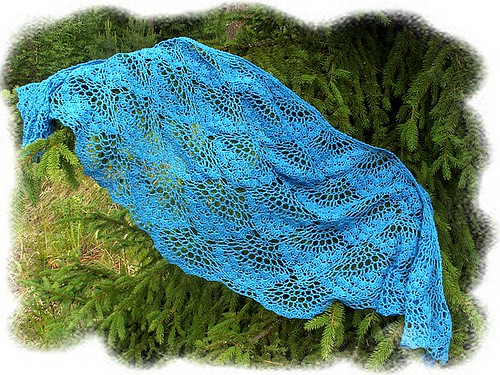
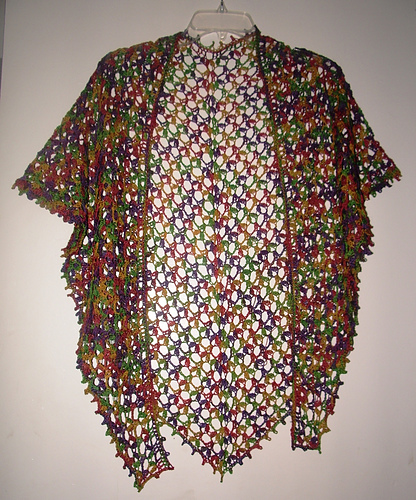
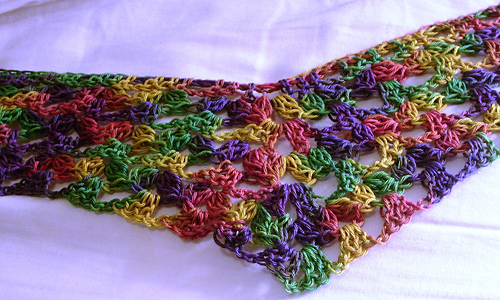
Crochet lace is one of the most beautiful forms of crochet, particularly when applied to the shawl or wrap. There are so many new patterns, like Evan Plevinski's Elise shawl that I completed last month and Vicki Mikulak's Flying Diamonds lace shawl that I crocheted as my Falling Leaves shawl last summer. My most recent Finished Object: Tealiscious Half-Granny Square lace shawl trimmed with a lace edging modified from a chart by MyPicot.com. The yarn is KnitPicks Bare --Merino Wool Fingering Yarn dyed in a bath of Shapna Organic Black Tea that has a wonderful red undertone. A traditional, lacey crochet pattern enhanced by a great lace edging.
A search of Ravelry's patterns reveals more than 925 crochet lace shawl patterns, just one-sixth of the slightly more than 5,420 knit lace shawl patterns. Thankfully, the number of crochet lace patterns is growing as many contemporary crocheters look past their grandma's crochet to explore the historical application of our art.
Piecework Magazine celebrates and expresses, through its articles and projects, historic and ethnic fabric-related handwork. Lace figures prominently in this effort. For the past three years, Piecework has featured lace in its May/June issue. For many lace lovers, these issues are a goldmine, filled with the history of lace and modern updates for replicating some of the lace. Unfortunately, it's a knitter's goldmine. Crochet is conspicuous by its relative absence.
A quick perusal of the index of the three Piecework issues reveals five crochet-related articles -- one about replicating Laura Ingalls Wilders filet crochet doily, one using painter's tape to help keep loops small and consistent, one about Maltese lace versus Maltese crochet (i.e., hairpin lace), and two about a Crochet Lace challenge to replicate an edging. There also was an article about "crochet tatting" but for the life of me, I don't know how one would confuse a tatting shuttle with a crochet hook. Three issues but only two patterns.
The three annual lace issues featured articles that illustrate the history of a certain technique or style of lace -- intricate Orenburg lace, lace bonnets from the Netherlands, and the story of Herbert Niebling (the grand master of lace knitting!). No stories about the Mlle. Riego de la Branchardiere, who published patterns to replicate raised Spanish needle lace. No articles abaout Cassandra Hand, wife of the local Church of Ireland minister who introduced Clones lace in 1847 as a famine relief scheme. No stories about the role pineapple lace has played in home arts. In the spirit of openess and transparency, in 1993, 1997, and 2005, Piecework had included a few articles about Irish lace. But nothing more recent than that.
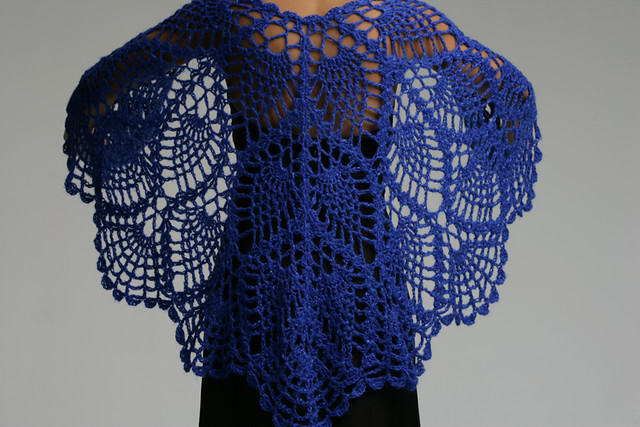
Admittedly, modern crochet, which dates to the early 1800s, is a relative newcomer to the realm of needle arts when compared to other handwork, such as knitting and embroidery. Yet, many contemporary fiber artists and designers endeavor to keep these arts alive, such as Doris Chan and her larger than life adaptation of pineapple lace to wearables, and Lisa Naskrent whose Dragonfly and Maia lace shawls seem to have a life of their own. Although my own lace shawls are not as intricate, I would hope that soomeday, my efforts (Bird of Paradise Shawl of my design) will, in some small way, help people recognize and celebrate the beauty that crochet lace is.
Perhaps it's best to let pictures do the talking. Olga Litvina, a Russian crocheter took a Japanese doily pattern and created this masterpiece!
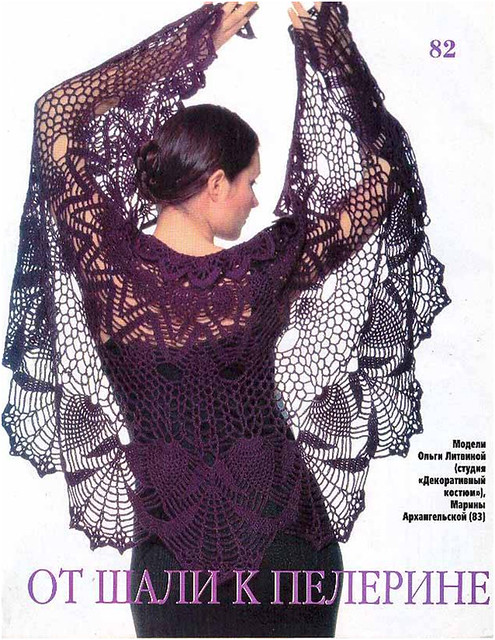
I'll say it again. Crochet lace is one of the most beautiful forms of crochet.
Showing posts with label lace. Show all posts
Feb 8, 2011
Sep 21, 2010
When All Else Fails . . .
. . . Follow Directions!
Linda, my friend and crochet mentor, often jokes that I am an "uptight crocheter" because I tend to crochet on the tight side. One would think I would have a strong preference for following written crochet instructions. Hah! I embarked on this project much in the same way I approach most of my crochet jobs crafted from someone else's pattern. First, I glance at the pattern, then memorize any repeat, and wing it from there. Unfortunately, my modus operandi didn't work here. Unlike all other shawls I have made, this pattern is not symmetrical, although the result is supposed to be. Clear as mud?
Rows 1 through 14. All was well -- symmetry reigned.
Lace shawls are all the rage now, with both knitters and crocheters. I think their ethereal beauty is what has been drawing fiber artists to them in droves in recent years. I've started making lace shawls, largely because of a real need to bust my stash, particularly of the lovely fingering and sock-weight yarns I have been lucky to receive in my various Ravelry swaps.
My current project is the Ostrich Feather Fandango Shawl, created by Tracey McCorkle. It is a very different shawl; its feathered shells add a three-dimensional quality to what traditionally are flat, two-dimensional pieces of fabric. See what I mean? It looks like it is ready to take flight.
This beautiful Ostrich Feather Fandango Shawl was crafted by |
Rows 1 through 14. All was well -- symmetry reigned.
Row 15. A shell seemed to be missing. Okay. Easy fix. I added one.
Row 16. Don't know why but it started with a sc but ended with three dc. Again, the shells were off. Thank goodness shawls are symmetrical and it is easy to match up the right and left sides. Fixed this one.
Row 17. Ughh! My wide shells and open shells and closed shells seemed to fall in all the wrong spots. And that nonsense about starting the row with a sc and ending with a dc just didn't seem right, right?
Row 18. Damn! Nothing is right. In fact, it's looking more than a bit lopsided.
Made the decision to frog, to rip back to the last symmetrical row. Printed out an updated version of the pattern, studied the offending rows, and marked up the margins like I used to do when cramming for college finals.
Row 15, again. Ignored the obviously missing shell.
Row 16, again. Worked it as written. Still not comfortable starting with a sc and ending with a dc.
Row 17, again. Made sure to count every stitch.
Row 18, again. Things are looking up. I'm beginning to see the symmetry. In fact, it's no longer lopsided.
Rows 19-21. Making progress. Finished the first repeat, although row 21 was a bit convoluted!
Rows 22-26. Finished the second repeat. Only another four or five repeats to go.
I guess I should have taken Tracey's cautionary notes to heart:
Tracey notes that several people have complained about the pattern because it is not truly symmetrical, although the finished product looks symmetrical! Last week, i would have been among that crowd. Now, after frogging, I see the error was with with me rather than with Tracey's pattern. Admittedly, I would only recommend this pattern for advance crocheters who feel they can grasp the pattern and then recreate it themselves through the repeats.
Now that I am following directions, this shawl is going to be beautiful when completed. I already have a recipient in mind.
Row 16. Don't know why but it started with a sc but ended with three dc. Again, the shells were off. Thank goodness shawls are symmetrical and it is easy to match up the right and left sides. Fixed this one.
Row 17. Ughh! My wide shells and open shells and closed shells seemed to fall in all the wrong spots. And that nonsense about starting the row with a sc and ending with a dc just didn't seem right, right?
Row 18. Damn! Nothing is right. In fact, it's looking more than a bit lopsided.
Made the decision to frog, to rip back to the last symmetrical row. Printed out an updated version of the pattern, studied the offending rows, and marked up the margins like I used to do when cramming for college finals.
Row 15, again. Ignored the obviously missing shell.
Row 16, again. Worked it as written. Still not comfortable starting with a sc and ending with a dc.
Row 17, again. Made sure to count every stitch.
Row 18, again. Things are looking up. I'm beginning to see the symmetry. In fact, it's no longer lopsided.
Rows 19-21. Making progress. Finished the first repeat, although row 21 was a bit convoluted!
Rows 22-26. Finished the second repeat. Only another four or five repeats to go.
I guess I should have taken Tracey's cautionary notes to heart:
"PLEASE READ ALL INSTRUCTIONS, INCLUDING THE NOTES AT THE END OF THE PATTERN, BEFORE ENDEAVORING TO BEGIN YOUR SHAWL. THE NOTES FOLLOWING THE PATTERN WILL BE TO YOUR BENEFIT, AS THE SHAWL IS NOT SYMMETRICAL WHEN THE PATTERN IS BEING WORKED."
Tracey notes that several people have complained about the pattern because it is not truly symmetrical, although the finished product looks symmetrical! Last week, i would have been among that crowd. Now, after frogging, I see the error was with with me rather than with Tracey's pattern. Admittedly, I would only recommend this pattern for advance crocheters who feel they can grasp the pattern and then recreate it themselves through the repeats.
Now that I am following directions, this shawl is going to be beautiful when completed. I already have a recipient in mind.
Apr 23, 2009
Bird of Paradise Shawl
I am in love with lace. No, not the wearing of it. Rather the making the seemingly intricate stitches common to vintage lace shawls and scarves. It was with a bit of trepidation that I started what turned into my first full-sized lace anything! Dubbed my Bird of Paradise shawl, it is a celebration of the colorway and feather display that seems to be taken directly from these tropical birds. The 64" wing span balances the 32" neck to tail feather body of the shawl. The narrower drape around the shoulders enable easier mobility when trying to chase a child or working at a computer all day. The cotton shawl can comfortably be worn throughout the year.
I started this project simply to make use of 440 yards of cotton yarn that just called out to me from the shelf of my local yarn store. I chose the Paradise Stitch pattern (page 61 of the old Harmony Guide to Crochet Stitches and Techniques) is very simple -- the rows of *3dc,ch3,3dc cluster stitch alternating with rows of *ch2, 3dc* repeats), which is reminiscent of the antenna-like head feathers of some male Birds of Paradise. Go here for pictures and more pictures of Birds of Paradise. This video shows these interesting birds in action.
Despite my earlier posts about Araucania Lonco Multy, I love this cotton yarn. It is smooth without being tightly wound, producing a drape that is wonderful, particularly with a 4mm (G) Hook. It was easy to work, with only an occasional splitting of the strand. For a cotton yarn, it took blocking well. But because of the lace, the fabric is so light that I don't anticipate it falling out of shape like most cotton garments.
Subscribe to:
Posts (Atom)