Showing posts with label cotton. Show all posts

Jan 28, 2013

A Wealth of Washcloths . . .


It seems as if I spent most of last year in pain.  No, not the pain of a watching a steadily deteriorating 2012 presidential election campaign, nor the pain of living in a swing state, although by the time November 6 had rolled around, I was ready to unplug myself from all modern -- and not so modern -- communication mechanisms.  And, no, not the pain of a slow recovery from two back-to-back minor car accidents that had me in weekly physical therapy for 6 months.

Rather, I'm talking about the pain of tendonitis.  For much of last year, I suffered from recurring tendonitis in my right wrist.  Tendonitis is a bitch, particularly when the inflammation holds hostage the very muscles one uses for a favorite activity.  At several points in the year, I would pick up my hook, make a hat or two, only to have to immobilize my wrist when the pain came flaring back.  Even a steroid shot didn't provide long-term help.

Happily, I can report that the inflammation is virtually gone.   As I struggled to figure out why the pain kept returning, I discovered that how I cradled my wrist when I crocheted further inflamed an already inflamed tendon. 

As  recovered, I took crochet slow and in small doses.  I focused on crafting a series of washcloths for my eldest, eldest niece, who recently moved to New York City where she is living on the shoe string budget of a struggling actress cum waitress.   As I experimented with ways to reduce the chance of aggravating the tendonitis, I toyed with different yarns (cotton, hemp, linen) and stitch patterns.  

I even managed to get over my dislike of the front post stitch.   Executed only on the front side of the fabric, in alternating rows, the fpdc created a beautifully textured designs, such as these two squares. 


Tree of Life Afghan pattern, LionBrand Yarns
Weldon's Practical Crochet, Second Series, ca1889
I made 12 washcloths last year.  I also ended the year with a wealth of knowledge about how to reduce the chance for injury, as well as gained a greater appreciation for the craft of crochet.
However, I still hate the back post stitch.


Mar 24, 2012

Anatomy of a Stitch: The Single Crochet

I remember my first crochet project -- a red cotton washcloth made entirely of single crochet stitches.  Not yet versed in counting my stitches or knowing where to begin the next row, the sides were basically straight, if a bit wonky.  My aunt's next door neighbor, a master crocheter if ever there was one, taught me how to form the requisite stitches -- the chain and single crochet stitches.  I still have that washcloth, somewhere, faded and misshapen from use.
 
The single crochet (sc) stitch is the second stitch (after the chain stitch ) most beginning crocheters learn.  It has been deemed one of the most important stitches every crocheter needs to know.  Many crochet patterns and projects incorporate single crochet stitches in some form or manner. I learned to crochet before the advent of the Internet and YouTube videos but the single crochet remains one of the easiest stitches to master.  Simply insert your hook under the loops of the next single crochet stitch in the row below, yarn over, pull through hole, yarn over, pull through both loops on the hook.  Pretty hunky-dory.

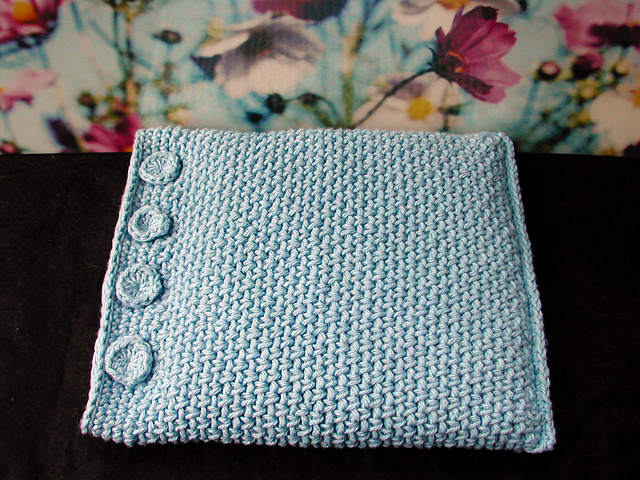
Okay, time for a bit of honesty.  The single crochet stitch, when used by itself, lacks . . . lacks . . . lacks beauty and style.  It is a very ugly stitch when worked flat and, occasionally, in the round.  The fabric it creates when worked in a straight row as shown in the border of the washcloth below, showcases each row, each stitch hole, in painful detail.  One can easily see the "knots" that make crochet fabric so thick and unwielding, and so unattractive that it dissuades many from picking up a hook.  The resulting fabric is just plain fugly; it does not drape well, not even when worked with an overlarge hook.  Can you tell that I am just not a fan of this stitch? 

Several years ago, I made my first lace shawl.  Its recipient remarked that she did not know that crochet could be so beautiful. Praise and damnation.  Unfortunately, the only crochet she had seen were "old-fashioned" granny squares, and single crochet washcloths and hats.  She had not been exposed to the beauty of crochet, which lies in the variety of textures and patterns that can be produced when basic stitches are used in combination with other stitches.  You'll find that this is particularly true for the lowly single crochet stitch that seems to blossom when used in combination with other stitches (i.e., chain, half-double crochet, double crochet, etc.). Take another look at the washcloth below.  The rigid bands of single crochet surround shells created by placing 3 sc stitches into one stitch.  A totally different fabric that looks less like a bunch of neat knots in a row and more like textured fabric.  Worked in the proper sized hook, the resulting fabric is full of drape.


Single Crochet-Chain combination:
In recent years, I have avoided the single crochet, opting instead for the half double crochet when making hats in the round, 5- and 7-double crochet stitch shell patterns for afghans, and double crochet-chain combinations for lace shawls.  Anything but straight sc.  But I''ve found some neat patterns calling for single crochet in straight rows.  Hunting around for alternatives, I found instances where some crocheters  substituted a sc-ch combination where you sc into the chain in the previous row and ch one, skipping the sc in the previous row.  This creates a relatively solid frabric with a semi-criss cross texture (see below) that lays flat, is stretchy when pulled from the top and bottom, but stable when pulled from side to side.  The stitch combination works in the round as well.  Two examples -- a washcloth worked flat and a heating pad worked in the round.


2005 by Donna Hulka
Split Single Crochet:
This is more about hook placement rather than stitch combination.   Instead of working into the top loops of the stitch in the row below, you insert your hook between the 2 vertical legs of the single crochet stitch in the previous row,  See my previous post for more information about how this works when working flat versus working in the round.


Here, a series of split-sc stitches alternates with a series of chain to produce what could pass for sloppy garter/stockinette.  When blocked, this fabric stretches easily from side to side but less so when pulled top to bottom.
There are infinite possible ways to use the single crochet stitch.  Obviously, you can work it in straight rows.  More importantly, you can also use it as a building block for creating more complicated stitches when used in combination with itself and other stitches. 

Sep 14, 2009

Wyld Ryd


Almost every Saturday, I volunteer at a genealogy library. Volunteering means hanging with my other crochet buddy, Meredith, who always inspires me to think outside the box when it comes to crochet and knitting. We discuss our current projects, new yarn finds, our families, our ancestors. It is, after all, a genealogy library and we are there to help patrons with their often elusive family searches.

Last Saturday, on my way to my "volunteer" (a genealogy library but my girls have always called it going to the volunteer), I pulled up behind a black Lexus sporting license plates that read "WYLD RYD." I thought, what a great title for a blog, but gave it up because cars and crochet don't mix, right!?.

I had brought my ball winder with me to wind a few skeins of yarn in preparation for some lace projects I am getting underway. Holiday gift giving and all that. Note to Vern and Con: yes, you each will be getting a lace shawl. I don't own a yarn swift so I thought I would take advantage of the highback chairs at the center to serve as an extra pair of hands. First up was a skein of KnitPicks Bare Peruvian Highland Wool fingering weight. Gonna use this for StitchStud's Peacock Track Mystery Crochet-A-Long. I plan to dye it in peacock blues and greens. Next up, Martha's Vineyard Fiber Farm's Sock Weight, perfect for an oversized scarf. Although the chairs were a tad bit narrow to hold the yarns with any real tension, the skeins rolled off nicely as I wound them into balls. Then came Araucania's Lonco Multy. Some of you already are aware of
my love-hate relationship with this yarn. I've been avoiding working on a second Bird of Paradise Shawl because of the hours spent unraveling this tough little cotton yarn.

Hoping to avoid any opportunity for a mishap, I grabbed the leather office chair. Its back is wider so it should hold the yarn better. As I cautiously started to unwind the skein, the chair shifted, revolving slowly like a yarn swift. I pushed it along and the yarn came off with little hesitation. I held my breath. The chair jerked to a stop as the yarn snagged. I cursed the yarn and wondered why I even bothered. In frustration, I gave the yarn a little downward tug, surprisingly freeing the yarn. I nudged the chair, smooth sailing for a few yards. Another snag, another damn, another tug.
I spun the chair, faster. Another snag, another tug, finally, freedom. Soon, the chair was turning like a kid spinning on a merry-go-round. Patrons walking into to the library stopped short, fascinated by the spinning chair as yarn was pulled off and formed into a little ball. Finally, the last length of yarn left my hand, completing the new yarn ball. I reached out, stopped the chair, and took a deep breath -- I had been holding my breath somewhat. What took 13 hours to wind the first skein, only took 45 minutes for this ball. Cue the chorus of angels. I was in yarn heaven.

Lesson learned?
Yarn can be quite temperamental. Some can be quite easy going, allowing you to wind it up with a child's helpful arms. Others need a swift kick in the @#$ and can only be controlled by the unyeilding arms of a yarn swift. Although I know that the unusual way the Araucania Lonco Multy was put up into a skein had a lot to do with my earlier problems, I realize that I had unwittingly created more twists and turns as I tried to "figure out" each and every snag by untwisting every perceived twist, only to twist it upon itself even more. Human nature being what it is, we try to outwit such yarn and think ahead of a snag, a twist, a perceived tangle. But under the constraint of a yarn swift, you are forced to let the swift and the yarn work together. Your hand just goes along for the ride.

So, if you need an extra pair hands and no yarn swift is handy, go to work and give that office chair a wyld ryd.

P.S. Get yourself some Araucania Lonco Multy but don't forget the swift.

Jun 13, 2009

Dream a Little Dream of Me


I had the weirdest dream last night.

I've been off my crochet game the past few weeks, preoccupied with work (new President, new Administration, new priorities, same old deadlines, longer hours), playing chauffeur to teens who had to get to and from after-school chorus rehearsals and evening chorus concerts, and squeezing in birthday pool parties for not one but two teens. All that to say that I haven't picked up a crochet hook save to put it with its mates. Nothing on my hook, nothing in my blog. But then I had this dream.

In my dream, I was sitting with friends (aka crochet buddies) and I pulled out my current project and started to work. The dream ME blithly drew up various parts to a child's sweater -- two front panels, the back, one complete sleeve, and the beginnings of a second sleeve. The dreaming voyeur ME was a bit taken aback. For one, I don't have a current project even started, let alone lacking all but a right sleeve. And second, I don't even recognize the yarns. The lightweight sweater draped leisurely across my hands and seemed to be made of sport or DK pima cotton of deeply saturated colors. Most of the sweater was crocheted from a lovely shade of emerald green with a touch of buttered sweet corn yellow striping tossed casually near the top of the setpin sleeve but just below the drop shoulder, which had a couple of rows of mutely varigated ballet pink and cherries jubiliee and forest pine and sunbeam yellow. Nothing remotely like those yarns in my stash.

The sweet little sweater was crafted in simple hdc (I think). Perhaps it was a shell pattern, perhaps not; I didn't get a close look. But what I do remember admiring about "my work" was the multi-colored row of delicate little rosebuds clusters ringing the edge of the drop shoulder. Actually I (the dreamer) was quite proud of the job I had done so far.

Like most dreams, my midnight reverie turned to other matters. I don't remember much else because soon thereafter, I awoke. When my head cleared, I began to wonder -- had I seen this little diddy somewhere or did I dream this up (so to speak)?

May 21, 2009

It's Easy to be Green (or Blue or Red or Yellow or . . . )


Who says market bags have to be boring? Who says they have to be bland to be eco-friendly? With just the right yarn, one can turn vanilla beige into a Sinfully Beautiful Vintage Shopping Bag in a deep royal blue.

The original vintage pattern (Bestway Leaflet 1240) calls for this round market bag to be made of double stranded 4-ply string. Not finding any string, I chose to soften things up a bit with Omega's Sinfonia 100% mercerized cotton sport weight yarn, which I also worked in a double strand. Surprisingly, I was able to make the same guage as called for in the pattern.

The resulting pattern is quite stretchy: I easily stuffed eight 7-oz skeins of Red Heart yarn in it with no problems whatsoever. Imagine the groceries you can stuff in this little bag.


Apr 23, 2009

Bird of Paradise Shawl


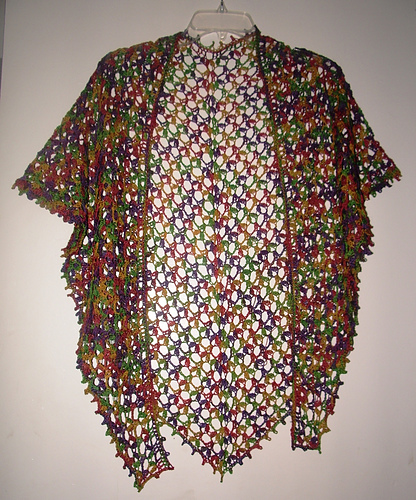
I am in love with lace. No, not the wearing of it. Rather the making the seemingly intricate stitches common to vintage lace shawls and scarves. It was with a bit of trepidation that I started what turned into my first full-sized lace anything! Dubbed my Bird of Paradise shawl, it is a celebration of the colorway and feather display that seems to be taken directly from these tropical birds.
The 64" wing span balances the 32" neck to tail feather body of the shawl. The narrower drape around the shoulders enable easier mobility when trying to chase a child or working at a computer all day. The cotton shawl can comfortably be worn throughout the year.

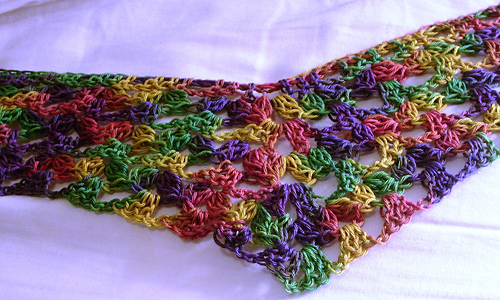
I started this project simply to make use of 440 yards of cotton yarn that just called out to me from the shelf of my local yarn store. I chose the Paradise Stitch pattern (page 61 of the old Harmony Guide to Crochet Stitches and Techniques) is very simple -- the rows of *3dc,ch3,3dc cluster stitch alternating with rows of *ch2, 3dc* repeats), which is reminiscent of the antenna-like head feathers of some male Birds of Paradise. Go here for pictures and more pictures of Birds of Paradise. This video shows these interesting birds in action.


Despite my earlier posts about Araucania Lonco Multy, I love this cotton yarn. It is smooth without being tightly wound, producing a drape that is wonderful, particularly with a 4mm (G) Hook. It was easy to work, with only an occasional splitting of the strand. For a cotton yarn, it took blocking well. But because of the lace, the fabric is so light that I don't anticipate it falling out of shape like most cotton garments.


The shawl is done and has flown the coop. It has been sent on to my swap buddy in Iowa. I hope she enjoys it.
I will be posting the pattern soon. Now on to another lace shawl.