Showing posts with label scarf. Show all posts

Jun 25, 2009

Pattern: Collared Tippet

Type: One Skein Wonder
Skill Level: Easy Skill Builder
Wearability: Fun
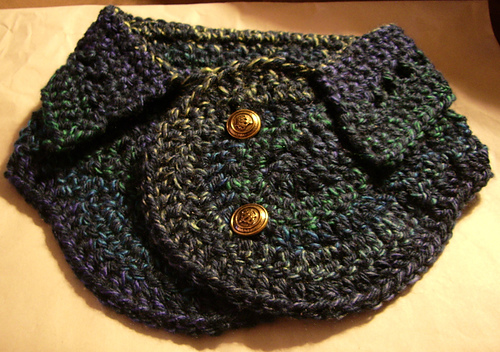

This scarf is militaristic in style with a pointed collar and round epaulets that form the front of the scarf. The look is finished with metallic buttons. Although the body is worked in a flat round without turning, the collar is worked by turning between rows.

Supplies

Yarn: Approximately 120 (100,80) yards of a DK (worsted, Bulky) weight of your choice. Just remember to pick something that feels good against the skin and isn't too rigid. For those comfortable with boucle style yarns, feel free. Just remember to use your stitch markers.

Hook: H or other to get gauge

Stitch markers

2 Buttons

TIP: Hate counting stitches over and over again? Keep your sanity by using stitch markers to mark the beginning and ending stitches for both sides of the base.

Gauge

Go ahead! Feel free to use a DK weight or a worsted/aran weight or even a bulky weight yarn. This pattern offers instructions for all three -- which is indicated by DK (Worsted, Bulky).

  • DK [3]: 16 dc + 10 rows = 4 in -- I used James Brett's Marble in Navy
  • Worsted/Aran [4]: 12 dc + 8 rows = 4 in -- I used Naturally Caron's Country in Teal
  • Bulky [5]: XX dc + X rows = 4 in -- I used Lion Brand Suede

TIP: Love how your swatch looks but can't make gauge? If changing your hook doesn't work (i.e., you don't like how the effect), try adapting the number of starting chains. Here's how: Given that the base of the scarf at the first row is 16 inches, multiply the number of dc stitches from your 4 inch gauge by 4 and then add 5. For example, if your swatch is 15 stitches = 4 inches, then chain 60 + 5 = 65 chains.

BODY

Ch 69 (53, XX).

Rnd 1: 2 dc in 4th ch from hook (counts as first dc); dc in each of next 64 (48, XX) ch, 6 dc in last ch; pivot (no turn) to work in free loops along opposite side of foundation ch, dc in each of next 64 (48, XX) ch, 4 dc in last ch; join with sl st in top of beg ch [124 (108, XXX) sts]

TIP: To help the scarf to lay flat, work stitches into the bump of the chain.

Rnd 2: Ch 3 (counts as first dc on each succeeding round), dc in same space as join, 2 dc in next dc, 4 dc in next dc, dc in next 64 (48, XX) dc, 4 dc in next dc, 2 dc in next dc, 3 dc in each of the next 2 dc, 2 dc in next dc, 4 dc in next dc, dc in next 64 (48, XX) dc, 4 dc in next dc, 2 dc in next dc; 3 dc in next 2 dc, 1 dc in next dc, join with sl st in top of beg ch [148 (132, 1xx) sts]

NOTE: The base of the scarf will always be the same width and is represented by those stitches which form the top and bottom straight edges of the scarf. In this pattern, these stitches are illustrated as "64 (48, XX)."

Rnd 3: Ch 3, 2 dc in next dc, (dc in next dc, 2 dc in next dc) 3 times, dc in next 64 (48, XX) dc, (2 dc in next dc, dc in next dc) 4 times, 2 dc in next two dc, (dc in next dc, 2 dc in next dc) 4 times, dc in next 64 (48, XX) dc, (2 dc in next dc, dc in next dc) 4 times, 2 dc in next two dc; join with sl st in top of beg ch [168 (152, 1xx) sts]

Rnd 4: Ch 3, dc in next dc, (2 dc in next dc, dc in next two dc) 3 times, 2 dc in next dc, dc in next 64 (48, XX) dc, (2 dc in next dc, dc in next two dc) 9 times, 2 dc in next dc, dc in next 64 (48, XX) dc, (2 dc in next dc, dc in next two dc) 5 times, 2 dc in next dc; join with sl st in top of beg ch [188 (172, 1xx) sts]

DK and Worsted weight only:

Rnd 5: Ch 3, dc in next dc, (2 dc in next dc, dc in next three dc) 3 times, 2 dc in next dc, dc in next 64 (48, XX) dc, (2 dc in next dc, dc in next three dc) 5 times, dc in next dc, (2 dc in next dc, dc in next three dc) 4 times, 2 dc in next dc, dc in next 64 (48, XX) dc, (2 dc in next dc, dc in next three dc) 5 times, dc in next dc, 2 dc in next dc, dc in next dc; join with sl st in top of beg ch [208 (192, 1xx) sts]

DK weight only:

Rnd 6: Ch 3, dc in next dc, (2 dc in next dc, dc in next four dc) 3 times, 2 dc in next dc, dc in next 64 (48, XX) dc, (2 dc in next dc, dc in next four dc) 5 times, dc in next dc, (2 dc in next dc, dc in next four dc) 4 times, 2 dc in next dc, dc in next 64 (48, XX) dc, (2 dc in next dc, dc in next four dc) 5 times, dc in next dc, 2 dc in next dc, dc in next dc; join with sl st in top of beg ch [228 (212, 1xx) sts]

Fasten off and weave in ends.

COLLAR

Row 1: Going to base stitches, work 1 sc in each stitch of base, ch 1, turn [64 (48, XX) sts]

Row 2: sc in first sc, 2 sc in next st, sc in remaining stitches until 3 st remain, 2 sc in next st, sc in last sc, ch 1, turn [66 (50, XX) sts]

Row 3: Repeat Row 2 [68 (52, XX) sts]

Row 4: Repeat Row 3 [70 (52, XX) sts]

Row 5: dc in first sc, sk next st, ch 1, 2 dc in next st, sk next st, ch 1, dc in next st, sk next st, ch 1, repeat to last three stitches, 2 dc in next st, sk next st, ch 1, dc in last st [72 (54, XX) sts]

Row 6: Repeat Row 4 [74 (56, XX) sts]

Row 7: Repeat Row 6 [76 (58, XX) sts]

Row 8: Repeat Row 7 [78 (60, XX) sts]

Fasten off and weave in ends.

FINISHING

Attach buttons to rounded epaulets, trying on to ensure proper placement.

copyright June 2009, Victoria Robinson

Mar 24, 2009

Great Minds and All That


OH. MY. GOD! I just discovered that the Triple Curve Stitch pattern I used for my Royal Lattice scarf is similar to the pattern crafted by Leigh Radford for her Blizzard Scarf (published in Scarf Style). A slightly modified version is the basis for Marianne Forrestal Airy Spring Throw profiled in the Mar/Apr 2009 issue of Crochet Today. Radford turned her scarf on its side, crocheting up the 84-inch long span to a 27-inch rise, while my scarf rises 44 inches up from an 11-inch base. Forrestal modified the vase-lie diamonds from which the curved stitches seem to spurt like a fountain by adding a v-stitch and integrating intermitten rows of double crochet in with the single crochet.

Although it appears all three scarves/shawls are based on the Triple Curve Stitch profiled in the Harmony Guide to Crocheting: Techniques and Stitches, each is finished very differently. Radford's features two rows of sc, while Forrestall goes quite fancy with a lacy scalloped edging. I opted for something in between with a mosaic border from a simple dc, ch1, 4dc cluster, ch1 repeat.

I'm generally satisfied happy with how my scarf turned out, despite the fact that blocking opens up the stitch pattern but looses the texture and springyness inherent in Paton's 70% bamboo/30% sik blend. It's just that 11 inches by 43 inches is just an awkward size for an open pattern stitch. I'm going to have to put it back among my works in progress until I can double it's size. More later about how I do that.

Nov 2, 2008

Tippets Galore -- Busting some stash!

To paraphrase all the Leisure Arts how-to-craft books, I can't believe I'm crocheting! Actually, I took back the hook with a vengence about a couple of weeks ago. Since then, I have completed six small projects, just to test out my arm, albeit with baby steps.

I have three active swaps on Ravelry, two of which require a handcrafted item. The holidays are fast approaching, as are birthdays for a few friends. Of course, I could sew up a few gifts but just couldn't think of anything I wanted to make. I started looking at yarn in my stash for inspiration -- determined was I to not buy any new yarn -- I seem to be going up rather than down. I also looked at one-skein patterns that called out for similar yarn. I stalked projects completed by other ravelers within the discussion groups I subscribe to. I searched for simple yet elegant patterns. And I found this wonderful neck scarf by Lion Brand Yarn. Forget the official pattern picture because I saw what other Ravelrs did with the pattern and they are wow!

Some folks call these neck warmers or mufflers -- I like what the Brits call them -- tippets -- a stole or scarf-like narrow piece of clothing, worn around the arms and above the elbow but I like the short version that closes at the neck. Each scarf took about three to four hours to complete, including weaving in the inevitable loose ends and sewing on the buttons. My models were getting tired of repeatedly trying on the scarves as I sought to position buttons and pins.

My first attempt was this blue mohair muffler made from Kartopu's Eva, a lapis blue mohair acrylic boucle blend (what a mouthful, try saying that fast 10 times). Yet, I couldn't deal with the flower although the brown and purple version crafted by Sia on Ravelry is what inspired me to even attempt the pattern. Instead of the flower, I paired this with three tiny pearl buttons that just peep through to make their presence known. I gifted my mohair blue neck warmer to a friend for her birthday (a very active and youthful 50th). Perfect timing because the weather had taken a steep dip as we all struggle to stay warm during our morning commutes.

My second version of this pattern was this vintage-inspired "tippet" made of Dalegarn's Heilo in pine. I trimmed the scarf with the bit of James Brett's Marble in Moss leftover in my stash, recently frogged from my first serious attempt at making a scarf in stockinette stitch (which I never finished because I couldn't find another skein in this colorway). So, there really wasn't much left to do anything with so trim it had to be. Rather than a flower, I added a pewter button and a second row of shells. I love how it turned out. It can be worn several ways:


I hope my Vintage swap spoilee likes it as much as I like her work. In fact, it was her tiny tippet that inspired me to look for something in crochet.

My third is this soft Chilean cotton neck warmer (see the top of this post), again without a flower. The beauty of this hand-dyed cotton is accented by Naturally Caron's Country trim. The vintage brown button is the final touch. I couldn't believe how incredibly soft this yarn is. I love to work in cotton because it really shows off crochet stitch definition. Yet sometimes, I miss the easy drape that comes with working in soft wool or high quality viscose. Araucania Pategonia Nature Cotton is a dream -- you get softness, texture, stitch definition, and wonderful color. Can you tell I like this yarn and want to get some more?

My fourth version of this pattern is the furthest from the original. Done in an unknown blue acrylic with intermitten twists of yellow, green, or turquoise strands, it forgoes the shells to focus on the form. It's kind of militaristic is style with a pointed collar and round epaulets that form the front of the scarf. Made with a blue yarn reminiscent of I don't know what but it is soft. This was a find in the skeins without a label bin at my LYS. I had hopes it was a James Brett Marble but don't really think so anymore.

My last two quick projects weren't scarves or tippets. Rather, the theme was things inspired by tea. I made this "tea towel" and tea cup cozy for one of my secret box buddies. Luckily, she doesn't know it is me so I can blog all I want about it because only I and the swap moderator know who she is. Both items were made using the split single crochet stitch (SSC) which produces a stitch that is reminiscent of the knitted stockinette stitch. The yarn was TLC Cotton Plus in white and dusty pink, leftover from my Delta-in-Training dress.

So, I'm on the mend, ready to tackle bigger projects. But, I like the tippets and want to explore the split crochet stitch even more. Next time in sock weight yarn or possibly DK. I wonder if it will look good done up in half double crochet or even, dare I say, double crochet? Hmmmm. Off to explore.